


Trenchless Pipe Bursting: Fast, Low-Impact Sewer Replacement is a trenchless method that pulls a new HDPE pipe through a failing buried sewer or supply line. Many homeowners first notice slow drains, a musty odour in the basement, or damp corners near the floor–wall joint when a lateral is failing. This article explains what pipe bursting feels like in everyday terms and what to expect during assessment and the work in the Toronto and GTA area.
If you’d like a free estimate or to discuss your situation, please contact us or call (905) 601-9449. Our licensed, insured crews offer 24/7 assistance and warranty-backed work, and we follow careful site practices to limit disruption to yards and hardscapes.
What Trenchless Pipe Bursting Is
This short bridge describes the method in clear terms for homeowners.
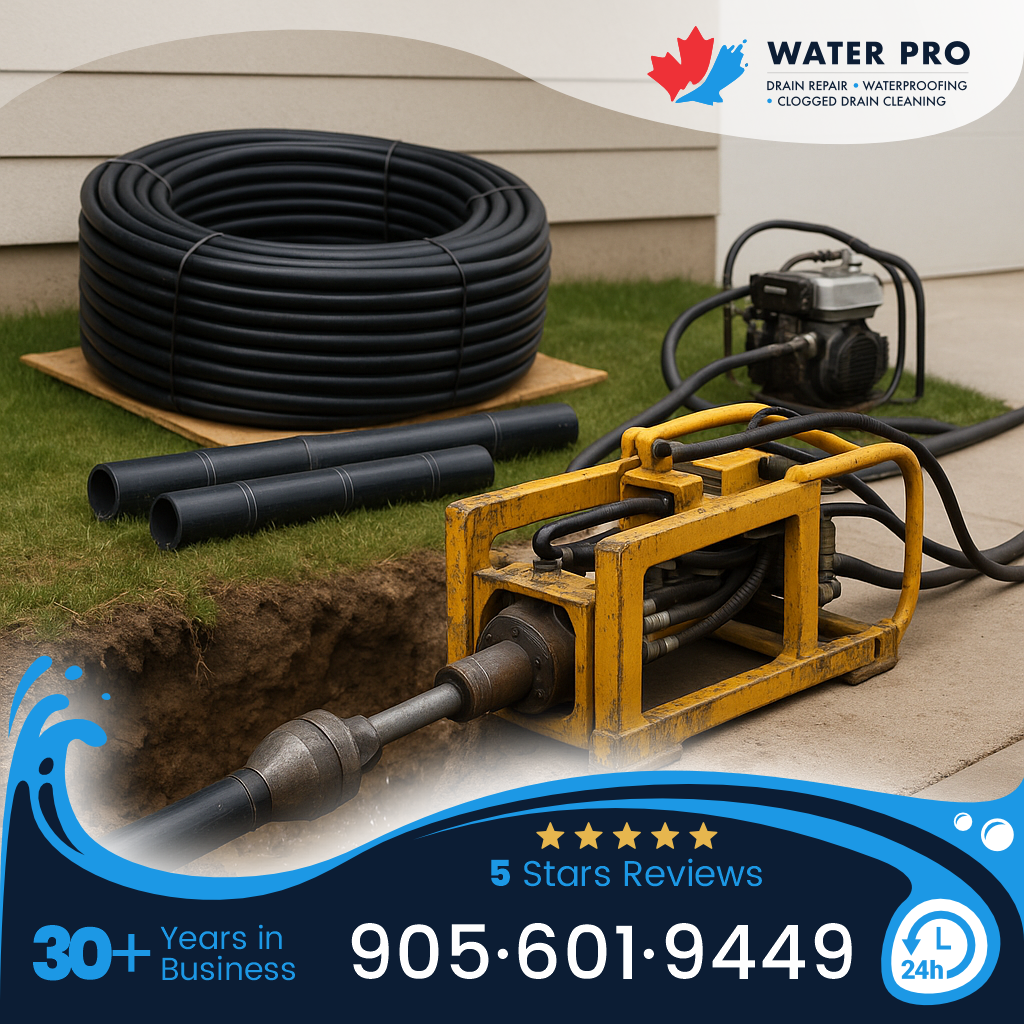
Pipe bursting is a trenchless replacement technique that removes the old pipe as a bursting head fractures or pushes it into surrounding soil while pulling a new HDPE pipe into place. The process replaces severely damaged, collapsed, or undersized laterals without digging long trenches through lawns or driveways. Many homeowners appreciate the reduced landscaping work and faster timelines compared with full excavation.
Common benefits include corrosion- and root-resistant piping and a minimized need for surface restoration. Before any work, we review grading, foundation details, and plumbing so the plan fits your home and local code.
When It’s The Right Option For Your Home
This bridge explains typical signs and practical suitability for pipe bursting in local homes.
- Severely damaged or collapsed clay, cast iron, or concrete laterals that cannot be lined effectively.
- Undersized sewer or supply pipes where upsizing (for example to 4″ or larger HDPE) reduces future backups and capacity problems.
- Properties where preserving landscaping, patios, or driveways is a priority and long trenches would be disruptive.
- Repeated backups or root intrusion where a replacement is more durable than repeated spot repairs.
For some runs, trenchless relining may be a better fit; ask about pipe & drain relining during your estimate so you can compare options and costs.
How Pipe Bursting Works — Step by Step
This bridge gives homeowners a clear sequence of the typical on-site process and what to expect during each stage.
Site Assessment and Preparation
This bridge outlines the initial diagnostics and small preparations most jobs require.
- CCTV camera inspection to confirm length, material, and exact problem locations. This helps plan access points and anticipate obstructions.
- Locate utilities and mark the route. Locating services and verifying clearance are routine parts of pre-work in the GTA and Golden Horseshoe.
- Create two small access pits or short excavations (entry and exit) sized to fit the bursting equipment. These are typically much smaller than a full trench.
- Discuss permits or boulevard access if the lateral runs under a public right-of-way; we include this in the initial scope so you know timing and responsibilities.
The Bursting Pull and Final Connections
This bridge summarizes the mechanical pull, the new pipe insertion, and the finishing steps homeowners notice.
- Technicians insert a bursting head into the old pipe and pull it while drawing the new HDPE pipe into place. Fragments of the old pipe are displaced into surrounding soil as the new pipe takes the original alignment.
- After the pull, service lines and connections are reattached and a final CCTV inspection confirms flow and alignment.
- Typical residential timelines: many lateral runs are completed in 1 day, with site restoration taking 1–3 days depending on surface type and weather.
- Clients often report relief after the work and clear maintenance steps, such as keeping trees trimmed near laterals and scheduling periodic CCTV checks.
Requirements, Permits, Timelines and Typical Costs
This bridge offers region-specific context for homeowners in Toronto, the GTA and the Golden Horseshoe about who pays, permit needs, and typical scheduling.
Private sewer laterals are usually the homeowner’s responsibility in many municipalities around Toronto and the GTA. When work crosses the public boulevard or ties into a main, municipal permits or approvals may be required. Before any work, we review grading, foundation details, and plumbing so the plan fits your home and local code.
Permits And Homeowner Responsibilities
This bridge highlights permit checks and routine responsibilities homeowners should expect.
Permit rules vary by municipality. For Toronto-specific guidance on permits that touch water or sewer infrastructure, you can review municipal information. In many cases, minor private-lateral work on private property does not require a city excavation permit, but work that affects the boulevard or public infrastructure usually does. We include permit checks in the initial scope so you know likely timeframes and fees.
- Typical permit fees in the region can range from a few hundred dollars to more, depending on the municipality and whether the public right-of-way is involved.
- Scheduling: routine private-lateral jobs are often booked and completed within 1–4 weeks for non-emergency work; emergency response is available 24/7 with different pricing and faster arrival times.
- We coordinate with local authorities when a permit or right-of-way work is required so you have a clear timeline up front.
For a concise municipal reference, see local permit information: City of Toronto water and sewer permits.
Costs depend on length, depth, obstructions, and surface restoration. A few numerical examples help set realistic expectations so you can compare bids and plan your budget.
- Per linear foot: many trenchless pipe bursting jobs in the GTA fall roughly between $150–$275 per linear foot, site dependent.
- CCTV camera inspection is commonly $300–$500 and is a valuable diagnostic step before quoting work.
- Typical residential totals for a 25–40 ft lateral often range from about $4,000 to $12,000, plus permit fees and any special restoration for driveways or patios.
- Factors that raise cost: deep or heavily obstructed lines, the need to upsize beyond standard diameters, and complex surface restoration such as stamped concrete or interlocking stone.
What To Expect, A Mini Case Example, And Next Steps
This bridge calmly explains risks, gives a short numeric case, and provides a practical checklist for homeowners who want clear next steps.
Risk and limits are part of every job. Some collapsed sections may require a small spot excavation before bursting. Certain soil conditions or buried obstructions can complicate the pull. Every property has nuances; we talk them through so you feel informed and comfortable. If unexpected conditions appear during work, crews will discuss options and impacts to schedule and cost before continuing.
Mini case example:
- Scenario: 30 ft clay sewer lateral under a suburban driveway in the GTA. CCTV confirms multiple collapsed sections and root intrusion.
- Planned work: pipe bursting to 4″ HDPE, with two small access pits at each end of the run.
- Cost estimate breakdown: CCTV $400, pipe bursting (30 ft × $200/ft) ≈ $6,000, minor driveway edge repair $900–$1,200, permit and admin $300. Total ≈ $7,600–$7,900 depending on final restoration choices.
- Timeline: assessment and permits (if needed) 1 week, on-site bursting and reconnections 1 day, surface restoration 1–3 days.
Homeowner checklist before you schedule work:
- Request a CCTV report and a written scope that lists timeline, costs, and what parts of the site will be affected.
- Confirm the crew is licensed and insured and ask about warranty terms for both pipe and workmanship.
- Ask how landscaping, driveways, and sidewalks will be restored and whether temporary access or neighbours will be affected.
- Discuss options for related work such as sump upgrades, backwater valves, or other plumbing services so you can plan holistically.
Next steps we typically take with homeowners are straightforward. We perform a CCTV inspection, locate utilities, prepare a written estimate that lists expected timelines and restoration, and book work once you are comfortable with the plan. Many clients feel relieved after replacement and leave with simple maintenance steps and a schedule for future inspections.
If you’d like a free estimate or to discuss options for your property, please contact us or call (905) 601-9449. Our teams are available 24/7 for urgent concerns and schedule routine assessments during regular hours.
This article offers general information for homeowners and is not engineering, legal, or plumbing advice. Assessments and solutions are reviewed during an on-site visit by licensed professionals. If you’re considering waterproofing or drain work, feel free to contact us or call — we’ll discuss your goals and outline a plan that feels comfortable and right for your home.
🔗 Learn more: https://waterproofingdrain.com/
📞 Call us: 905 601-9449
✉️ Write us: info@waterproofingdrain.com
🕒 Open hours: Mon – Sat, 9:00am – 9:30pm