
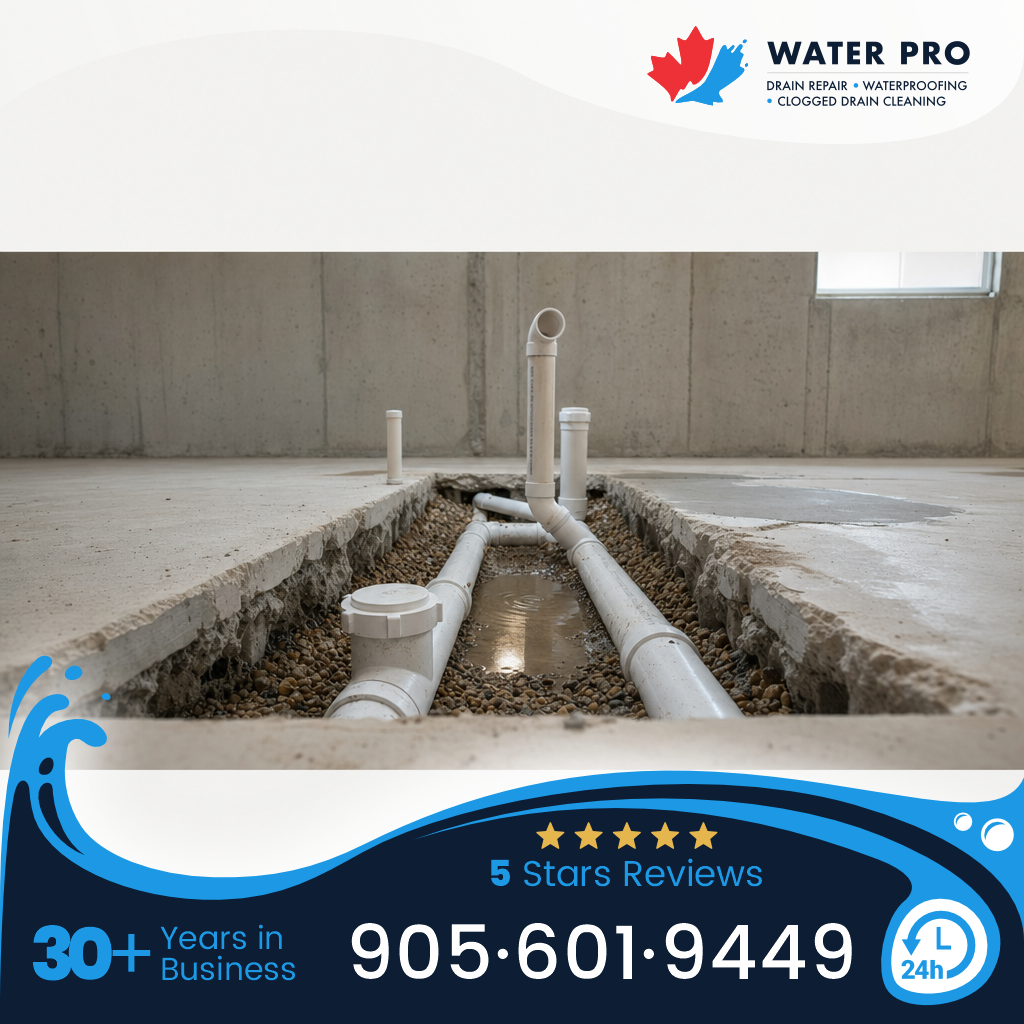



Rough-In Installation: Set Up Plumbing Before Finishing is the step that places hidden water supply, drain and vent lines before drywall and flooring go in. Many homeowners first notice the need for careful rough-in when a renovation pauses for plumbing issues, or when a musty odour or damp corner appears during framing. Early, accurate placement and correct pipe slope reduce the chance of rework later and make final finishing faster.
It’s helpful to know what the rough-in process typically feels like for a homeowner. During assessment you may see contractors mark the slab or walls, hear drilling for slab cores, and watch pipe runs get laid out. If you’d like to talk about a project or get a free on-site estimate, contact us or call (905) 601-9449.
Why Rough-In Placement Matters
Before any work, we review grading, foundation details, and plumbing so the plan fits your home and local code.
Correct placement sets where fixtures will connect and how waste and venting travel through the house. Many homeowners first notice moisture at the floor–wall joint or slow drains after the finish stage when pipes were shifted or pitched wrong. Proper pitch, venting and access to cleanouts help reduce the risk of backups and future cutting into finished surfaces.
- What rough-in controls: fixture locations, drain slope, vent routing and cleanout placement.
- What a good rough-in saves you: fewer finish delays, lower chance of slab cuts, and quicker inspections.
What Professionals Check and Local Code Considerations
Before any work starts, licensed plumbers confirm pipe sizes, slope, venting and whether gravity drainage is possible from each fixture.
Permit And Inspection Steps
Permits are commonly required for new basement bathrooms or changes to the main sanitary connection in the Toronto area.
- Typical steps: site review and permit application, rough-in inspection, and final inspection before finishes.
- Timing: plan 1–2 weeks for permit processing where applicable; inspections are scheduled by the municipality after the rough-in is exposed and ready.
- Documentation: have contractor licence details and invoices ready if you plan to apply for local subsidy programs.
When A Sewage Ejector Or Backwater Valve Is Required
Fixtures below the elevation of the main sewer or where the municipal sewer can surcharge will need special devices or pumps to move waste safely.
- Sewage ejector: required when a toilet, laundry or other sanitary fixture cannot drain to the building drain by gravity. An ejector basin, venting and check valves are typical elements.
- Backwater valve: may be required or recommended where the municipal sewer can back up; the City of Toronto has permit and subsidy guidance for these installs (City of Toronto backwater valve).
- Before any installation, a licensed plumber will review your site and recommend a permitted solution. For professional rough-in work, consider contacting our plumbing services team to discuss options and scheduling.
Typical Installation Steps, Timelines and Cost Ranges
This section outlines what most homeowners can expect during a rough-in and gives local cost and timeframes that are commonly seen in the Toronto & GTA area.
Typical Project Steps
Before any digging or slab work, the team confirms fixture locations, routing and pipe pitch so the work matches the plan and local code.
- Site review and layout: 0.5–1 day for measurements, marking and any minor design notes.
- Slab coring or trenching: 0.5–1 day, depending on access and number of runs. This is when drains and supply lines are placed under or through the slab.
- Rough plumbing: 1–3 days for a typical basement bathroom (drains, vents, supply lines, and cleanouts). Larger projects take longer.
- Inspection and corrections: an inspector typically reviews the exposed rough-in before insulation or drywall. Scheduling varies by municipality; allow 1–2 weeks for permit timing and booking where applicable.
- Restore and handover: concrete patches or trench backfill commonly take 1–2 days to complete, plus curing time before finishes begin.
Timelines And Cost Examples
Below are calm, local ranges based on common Toronto & GTA projects. Exact pricing depends on access, slab work, and whether a pump or backwater device is required.
- Basic 2–3 fixture rough-in without slab work: about $800–$2,500 and 1–2 days of on-site work.
- Rough-in with slab core and concrete restoration: about $1,800–$5,000 and 2–4 days on site, depending on restorations and patch curing.
- Mainline backwater valve installation with saw-cut and restore: commonly $2,800–$4,800 installed, plus permit and inspection time; some municipal rebate programs may apply.
- Sewage ejector pump system for below-sewer fixtures: typically adds $1,200–$4,000 depending on pump type, basin, venting and electrical work.
Mini-case: a three-fixture basement bathroom that requires an ejector pump often takes about 3 days on site for rough-in and basin work, with total project costs commonly in the $3,500–$7,000 range once permits and concrete restoration are included. Before committing, homeowners usually ask for a written scope, schedule and a permit plan so timing and costs are clear.
Common Mistakes, Risks And A Short Homeowner Checklist
Every property has nuances; we talk them through so you feel informed and comfortable about the plan and the trade-offs involved.
- Common mistakes: insufficient slope on horizontal drain runs, missing or undersized vents, lack of accessible cleanouts, and using the wrong pipe sizes for fixture loads.
- How these play out: poor slope or missing vents can lead to slow drainage, odours or the need for later slab cutting to correct the problem. These outcomes are avoidable with proper planning and licensed workmanship.
- Risk management: before work, we review grading, foundation details, and plumbing so the plan fits your home and local code. If a municipal subsidy or permit is needed, we help document the installation steps for inspection.
Homeowner checklist when reviewing quotes and contractors:
- Confirm the plumber’s licence and ask for references from similar basement projects.
- Request the permit strategy and who will book inspections.
- Ask where cleanouts and service access will be located, and how concrete or finishes will be restored.
- Request a written scope, timeline and warranty terms for the rough-in work.
- If a backwater valve or sump is part of the plan, ask about ongoing maintenance and annual checks; more information about these systems is available through our backwater valve & sump pumps service page.
Planning Your Rough-In Next Steps
A few considerations we review together are your fixture layout, whether gravity drainage is available, and whether an ejector or backwater device is needed for compliance and flood-risk management.
If you’re ready to move forward, schedule an on-site review so a licensed technician can measure, review permit needs and provide a free written estimate. To arrange a visit, contact us or call (905) 601-9449 for 24/7 assistance and permit support.
This article offers general information for homeowners and is not engineering, legal, or plumbing advice. Assessments and solutions are reviewed during an on-site visit by licensed professionals. If you’re considering waterproofing or drain work, feel free to contact us or call — we’ll discuss your goals and outline a plan that feels comfortable and right for your home.
🔗 Learn more: https://waterproofingdrain.com/
📞 Call us: 905 601-9449
✉️ Write us: info@waterproofingdrain.com
🕒 Open hours: Mon – Sat, 9:00am – 9:30pm