A basement crack can look small on Monday and become a wet, musty problem after the next hard rain. That is why real foundation repair examples matter: they show that the right fix depends on what caused the damage, where water is traveling, and whether the structure is still moving. In Toronto and across the GTA, older homes, clay-heavy soils, freeze-thaw cycles, and aging drainage systems can all put pressure on foundations.
The goal is not to cover a crack and hope for the best. It is to diagnose the source, stop active water or movement, and make a repair that protects the home for the long term. Below are common situations property owners face, what a professional repair may involve, and when a more substantial solution is needed.
Foundation Repair Examples That Start With a Proper Diagnosis
A visible crack is evidence, not a complete diagnosis. Before recommending work, a qualified foundation specialist should look at the crack pattern, its width, whether it is changing, signs of water staining, floor movement, exterior grading, downspouts, and the condition of nearby drains.
For example, a thin vertical crack in a poured concrete wall often has a different cause and repair path than a horizontal crack running across the middle of the wall. A crack beside a window can be related to settlement, while repeated water at the bottom of a wall may point to failed exterior waterproofing or clogged weeping tile.
Camera inspections can also be valuable when drainage trouble and foundation moisture appear together. A blocked or broken underground drain can keep water against the foundation, increasing hydrostatic pressure and turning a manageable issue into a recurring basement leak.
Example 1: A Vertical Foundation Crack Leaking During Rain
This is one of the most common calls in GTA homes. The homeowner notices a narrow vertical crack in a concrete basement wall. Most of the time it looks dry, but after prolonged rain, water seeps through and creates a damp spot or puddle along the floor edge.
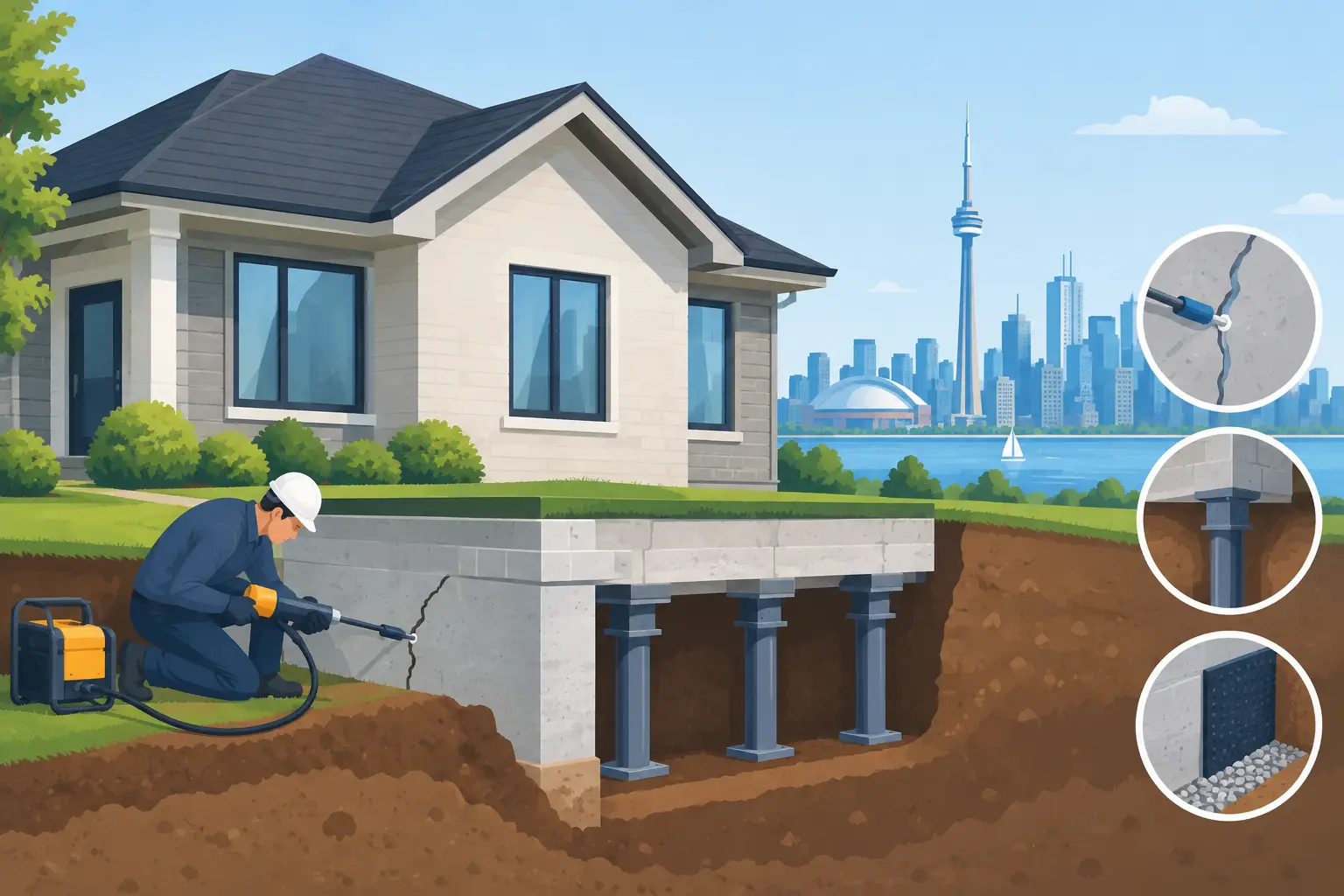
If the crack is stable and the wall is otherwise sound, an interior crack injection may be the right repair. Professionals inject specialized polyurethane or epoxy materials into the full depth of the crack. Polyurethane is often used where active moisture is present because it can expand and seal against water intrusion. Epoxy can restore bonding strength in certain dry, non-moving cracks.
This approach is efficient and minimally disruptive, but it has limits. It addresses the crack itself, not exterior water pressure. If grading sends roof runoff toward the house, or if saturated soil is pressing against the wall, a crack injection alone may not prevent future problems elsewhere. The repair plan may also include extending downspouts, correcting grading, or evaluating exterior drainage.
Example 2: A Horizontal Crack and a Bowing Basement Wall
A horizontal crack, especially one near the middle of a block or concrete wall, deserves prompt attention. It can indicate that wet soil outside the home is exerting enough force to push the wall inward. Signs may include a wall that looks bowed, stair-step cracks in concrete block, or a crack that widens over time.
The repair can range from reinforcement to structural rebuilding, depending on the severity. Wall anchors, carbon fiber reinforcement, or steel bracing may be appropriate when movement is limited and the wall can be stabilized. In more advanced cases, excavation and partial wall reconstruction may be necessary.
Water management is part of this repair, not an optional add-on. Relieving pressure with exterior waterproofing, new weeping tile, and proper drainage can help prevent the same forces from continuing to act on the wall. A repair that ignores the water source may stabilize the symptom without fully addressing the cause.
Example 3: Cracks at Corners Caused by Settlement
Settlement cracks are often diagonal and may appear at basement window corners, door openings, or the corners of a foundation wall. Inside the home, homeowners may also notice doors that stick, gaps around trim, sloping floors, or new drywall cracks above.
Not every settlement crack means the house is in immediate danger. Older homes can develop minor cracks as materials age and soils shift. The question is whether the movement has stopped. A professional inspection may compare crack width, check for uneven floors, review drainage conditions, and look for areas where water is washing out or softening supporting soil.
When settlement is ongoing or significant, underpinning may be recommended. Underpinning strengthens and deepens sections of the existing foundation so the home is supported on more stable ground. It is a larger project, but it can be the right answer when the issue is structural rather than surface-level.
For homes where owners also want more usable ceiling height, basement lowering and underpinning can be completed together. This requires careful engineering, staged excavation, and skilled workmanship. It is not a shortcut project, but it can improve stability while creating a safer, more functional lower level.
Wet Basement Foundation Repair Examples
A wet basement does not always mean there is a crack in the wall. Water can enter through the joint where the wall meets the floor, through porous concrete, around service penetrations, or because groundwater has nowhere to drain.
Example 4: Water Along the Basement Floor Edge
When water appears in a line around the perimeter of the basement, the problem is often hydrostatic pressure beneath or beside the foundation. During heavy rain or snowmelt, groundwater rises and pushes toward the path of least resistance. The wall-floor joint is a common entry point.
An interior waterproofing system may be a practical solution, particularly where exterior access is limited by decks, landscaping, neighboring properties, or paved areas. The process generally involves opening a narrow section of the concrete floor around the perimeter, installing an interior drainage channel and drainage stone, and directing water to a sump pit and sump pump.
This does not stop groundwater from reaching the outside of the foundation. Instead, it controls water safely once it reaches the drainage system. For many finished or partially finished basements, it is a reliable way to keep the space dry without major exterior excavation.
Example 5: Failed Exterior Waterproofing and Clogged Weeping Tile
In an older property, the original waterproofing membrane may have deteriorated and the weeping tile may be crushed, blocked, or simply unable to handle current groundwater conditions. The homeowner may see persistent dampness, white mineral deposits on the wall, peeling paint, musty odors, or water that returns after every storm.
Exterior waterproofing is often the more comprehensive repair when access is available. The foundation wall is excavated, cleaned, repaired where needed, sealed with a waterproof membrane, and protected with drainage board. New weeping tile can be installed at the footing level to carry water away before pressure builds against the wall.
This is more disruptive than a single crack injection, but it treats the foundation from the outside where water begins. The best choice depends on the layout of the property, the condition of the wall, the source of water, and the homeowner’s long-term plans for the basement.
Example 6: Sewer Backup Mistaken for a Foundation Leak
Not all basement water comes from groundwater. If water appears around a floor drain, has an odor, carries debris, or rises after fixtures are used, a sewer or drain issue may be involved. In some cases, homeowners assume they need foundation waterproofing when the urgent problem is a blocked sewer line or municipal sewer backup.
A drain camera inspection helps separate these issues quickly. It can reveal root intrusion, a collapsed pipe, offset joints, or a blockage that is forcing wastewater back toward the home. Depending on the condition of the line, repair may involve drain cleaning, hydro jetting, trenchless pipe relining, pipe replacement, or a backwater valve for future protection.
This distinction matters. Waterproofing a basement will not correct a damaged sewer lateral, and clearing a drain will not solve rainwater pressure against a cracked wall. Accurate diagnosis prevents money from being spent on the wrong repair.
What a Lasting Repair Should Include
The best foundation repair is not always the biggest or most expensive one. A stable, isolated crack may need a targeted injection. A wall under pressure may need reinforcement and exterior drainage. A settling home may need underpinning. The repair should match the evidence.
Ask the contractor to explain the cause in plain language, identify what is included in the scope of work, and clarify what the solution will and will not address. You should know whether permits, engineering, drainage improvements, restoration work, or sump pump maintenance are part of the plan. A clear estimate helps avoid surprises after the work begins.
For any repair involving water, consider the whole system: roof runoff, grading, downspouts, drains, weeping tile, sump discharge, and sewer protection. Foundations perform better when water is directed away from them.
If you see new cracks, repeated basement moisture, wall movement, or a flooded floor after rain, do not wait for the next storm to make the decision for you. Water Pro Master Corp can assess the problem, explain the practical options, and help protect your home with fast, clean work and no surprises.